Mineral Complex
A Closer Look at Whole-Food Mineral Sources in the Daily Eating Pattern
Sebastian Marsden
·

Adaptogens have entered the daily routine conversation steadily over the past decade, moving from specialist nutrition discussions to mainstream supplement formulation. The morning window — the period between waking and midday — has become the primary deployment zone for these compounds in active men's routines. This piece examines what published nutritional research currently says about adaptogens, and where within a structured morning habit they are most consistently observed.
The term adaptogen was formalised in the nutritional science literature in the mid-twentieth century, though the botanical compounds it describes have been in use across Asian and Ayurvedic traditions for considerably longer. In contemporary nutritional formulation, the adaptogen category typically includes ashwagandha (Withania somnifera), rhodiola rosea, panax ginseng, and eleuthero (Siberian ginseng). Maca root and lion's mane mushroom are frequently included in broader definitions, though their research profiles differ.
What these compounds share is a documented association, in published research, with the body's capacity to manage demands — including the physiological demands of sustained physical activity, concentrated work periods, and irregular schedules. The research base varies by compound: ashwagandha and rhodiola have the most extensive publication record among active men's supplement ingredients; maca root has a growing but smaller evidence base.
From an editorial standpoint, the Uldran Journal approach to adaptogen coverage is to cite published research accurately, to distinguish between compounds with strong documentation and those with emerging evidence, and to avoid inflating research findings into claims beyond their published scope. The marketing register around adaptogens is notably exaggerated; the research register is more measured and conditional.
"The research register around adaptogens is conditional and compound-specific. The marketing register, by contrast, tends to collapse these distinctions into a single category claim."Harriet Linwood — Uldran Journal, March 2026
The morning routine has a structural logic that makes it a natural anchor for supplement formulations. The window between waking and first food intake presents an opportunity for consistent habit formation — the same window that makes morning the most commonly reported time for supplement consumption in published surveys of active men.
The consistency argument for morning supplementation is not about any compound-specific timing requirement in most cases. Rather, the morning is simply the most structurally reliable point in many men's daily schedules. Habit formation research — which is adjacent to but distinct from nutritional science — suggests that anchoring a new practice to an existing reliable cue (waking, first coffee, first meal) increases long-term adherence. The morning window provides this anchor.
For adaptogen formulations specifically, there are some published indications that compounds like ashwagandha and rhodiola are better tolerated on a full stomach, making the morning period after first food intake a practical recommendation in published nutritional guidance. This is distinct from a biological timing claim — it is a tolerability observation.
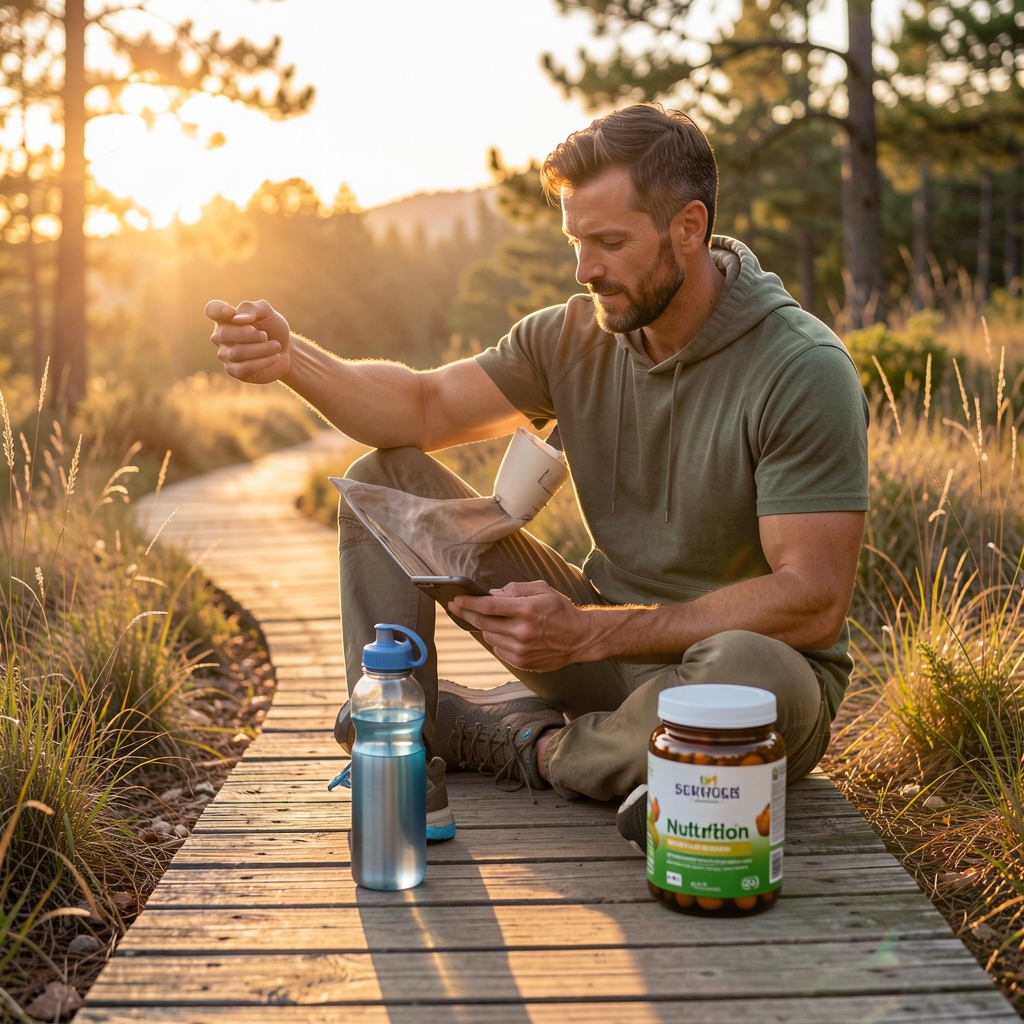
The morning outdoor routine — a documented anchor point for consistent supplement intake among active men.
Among the adaptogen compounds, ashwagandha (Withania somnifera) has the most extensive and consistently designed research record in the context of active men. Published studies — predominantly randomised controlled designs — have examined its role in contexts relevant to men sustaining physically demanding routines: endurance output, recovery between sessions, and self-reported measures of fatigue.
The KSM-66 and Sensoril extracts are the most frequently used standardised forms in published research, and are the forms most commonly cited in evidence-based formulation reviews. An editorial recommendation from Uldran Journal, where adaptogen formulations are considered, will always specify the extract standard rather than the raw botanical name — because the research base is tied to specific extraction profiles rather than the whole root.
Batch verification for ashwagandha formulations is particularly important because withanolide content — the active compound class in the root — varies significantly by soil origin, harvest timing, and extraction method. A formulation citing third-party batch verification and a standardised withanolide percentage offers considerably more traceability than an unlabelled whole-root preparation.
Rhodiola rosea occupies a slightly different position within the adaptogen category. Its research record is associated less with physical endurance and more with sustained cognitive function under prolonged demands — an area of particular relevance to men who combine professional workloads with active lifestyle commitments. Published research on rhodiola has been conducted in contexts including shift workers, students during exam periods, and professionals in high-demand roles.
The rosavin and salidroside compound classes within rhodiola are the primary subjects of published research. As with ashwagandha, the standardised extract form — most commonly referenced as 3% rosavin / 1% salidroside — is the research-relevant version, and is the version whose documentation Uldran Journal will reference in formulation evaluations.
The morning timing of rhodiola is more specifically documented than for ashwagandha. Published guidance consistently recommends morning consumption, with some indications that afternoon consumption can interfere with sleep onset — an observation from published nutritional practice that a structured morning routine naturally addresses without requiring a separate reminder habit.
An adaptogen formulation that meets Uldran Journal's editorial sourcing standard will carry the following identifiable elements: the botanical name including species designation, the extract standard and percentage of active compound class, the country of origin of the raw material, and a reference to third-party batch testing. This is not an exhaustive specification — it is a minimum documentation baseline.
Plant-based formulations that combine multiple adaptogens in a single product introduce an additional evaluation dimension: whether the individual compound dosages remain within the range documented in published research, or whether the stack format has diluted each ingredient below its research-relevant concentration. A formulation with five adaptogens at sub-research-dose concentrations is a different product category from a single-compound formulation at the research-documented level.
We recommend speaking with a qualified wellness or nutrition professional before introducing any new habit or routine to your daily life, particularly if you have specific dietary requirements. The documentation above is editorial in nature — it reflects the published nutritional research record, not a directive for individual practice.
Uldran Journal is an independent editorial publication focused on everyday wellness practices. The publication is not affiliated with any commercial, governmental, or institutional body. Articles published on Uldran Journal are editorial in nature and reflect the writers' observations on everyday wellness practices. The content is not intended as professional advice, nor as guidance for the management of any specific condition.

Harriet Linwood has written for Uldran Journal since the second issue, contributing to the publication's coverage of plant-based formulation and daily routine structuring for active men. She brings a research-first editorial perspective to compound-specific analysis. She writes from Jakarta, Indonesia.
More from this publication →